Free online tool • Mix ratios
Sand and Cement Calculator
This sand and cement calculator works out how many bags of cement and how much sand — and gravel, for concrete — you need to mix a slab, footing, screed or mortar bed yourself. Enter the area and thickness, choose a mix ratio, and get cement bags, tons of sand and gravel, and cost.
How Much Sand and Cement Do I Need?
Sand and Cement Mix Ratios
A mix ratio lists the parts of cement, sand and gravel by volume. Concrete uses all three; mortar and screed use only sand and cement. The sand and cement calculator includes the common ratios:
| Mix | Cement : sand : gravel | Typical use |
|---|---|---|
| High-strength concrete | 1 : 1.5 : 3 | Driveways, heavy slabs |
| General concrete | 1 : 2 : 3 | Patios, paths, slabs, posts |
| Lean concrete | 1 : 2 : 4 | Footings, foundations, mass fill |
| Strong mortar | 1 : 3 | Below-grade masonry, paver bedding mortar |
| General mortar or screed | 1 : 4 | Brick and block laying, floor screed |
Dry Volume of Sand and Cement
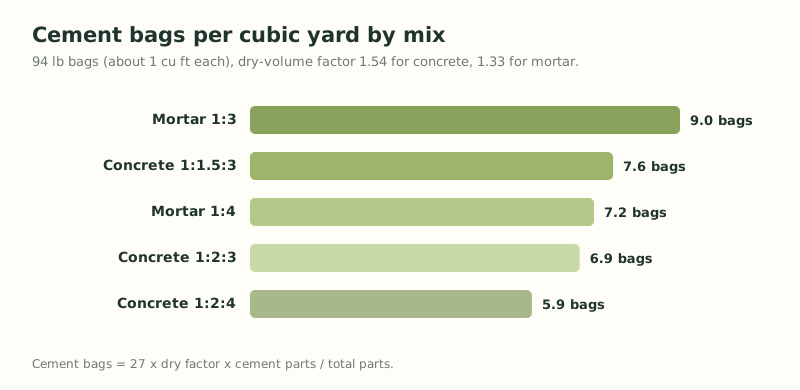
A cubic yard of mixed concrete needs more than a cubic yard of dry ingredients, because sand fills the voids between the gravel and cement fills the voids between the sand. The usual allowance is a dry-volume factor of 1.54 for concrete and about 1.33 for mortar. The sand and cement calculator multiplies your wet volume by this factor before splitting it into cement, sand and gravel.
Sand and Cement per Cubic Yard
| Mix | Cement (94 lb bags) | Sand | Gravel |
|---|---|---|---|
| Concrete 1:1.5:3 | 7.6 | 1,134 lbs | 2,352 lbs |
| Concrete 1:2:3 | 6.9 | 1,386 lbs | 2,156 lbs |
| Concrete 1:2:4 | 5.9 | 1,188 lbs | 2,464 lbs |
| Mortar 1:3 | 9.0 | 2,693 lbs | — |
| Mortar / screed 1:4 | 7.2 | 2,873 lbs | — |
Sand at 1.35 and gravel at 1.40 tons per cubic yard, dry and loose. Round cement up to whole bags.
How the Sand and Cement Calculator Works
1. Wet volume of the mix
Multiply area by thickness in feet. A 10 × 10 ft slab 4 inches thick is 33.3 cubic feet, or 35 cubic feet with 5 percent extra.
2. Dry volume
Multiply by 1.54 for concrete: 35 × 1.54 = 53.9 cubic feet of dry ingredients.
3. Split the sand and cement
A 1:2:3 mix has 6 parts. Cement is 1/6 of 53.9 = 9.0 cubic feet, or 9 bags of 94 lb cement. Sand is 2/6 = 18.0 cubic feet, about 0.9 tons. Gravel is 3/6 = 27.0 cubic feet, about 1.4 tons.
Concrete Sand vs Masonry Sand
Use coarse, washed concrete sand in concrete and screed: its sharp, varied grains pack tightly with the gravel. Use finer masonry sand in mortar for brick and block, where a smooth, workable paste matters more. Beach sand and unwashed fill sand contain salt, silt or clay that weakens the mix and should not be used.
Sand and Cement vs Ready-Mix
Mixing your own sand and cement makes sense for small jobs and mortar. For more than about a cubic yard of concrete, ready-mix delivery is usually cheaper, stronger and far less work. For very small pours, premixed bags are simplest: an 80 lb bag of concrete mix makes about 0.6 cubic feet, so a cubic yard takes about 45 bags. Keep water to the minimum that gives a workable mix — extra water makes concrete weaker.
Related Sand Calculators
These tools use the same volume and density maths for neighbouring jobs:
- Sand calculator — tons, yards and bags of any sand
- Masonry sand calculator — fine sand for mortar
- Sand and gravel calculator — base gravel and bedding sand
- Gravel under concrete slab calculator — the base under the slab
- 3/4 gravel calculator — the usual concrete aggregate size
- Cubic yards to tons calculator — convert any volume to weight
Mix proportions are common rules of thumb for site-mixed concrete and mortar; the Portland Cement Association publishes guidance on concrete design and mixing.
Sand and Cement FAQ
How much sand and cement do I need for a cubic yard of concrete?
For a 1:2:3 concrete mix, one cubic yard needs about 7 bags of 94 lb Portland cement, 1,400 lbs of sand and 2,150 lbs of gravel. A leaner 1:2:4 mix uses about 6 bags, 1,200 lbs of sand and 2,450 lbs of gravel.
What is the ratio of sand to cement for mortar?
General-purpose mortar is about 1 part cement to 4 parts sand by volume, and a strong mortar is about 1 to 3. Lime or masonry cement is often added to improve workability.
How do I calculate sand and cement for a screed?
Multiply the floor area by the screed thickness in feet to get cubic feet, multiply by 1.33 for dry volume, then split it 1 part cement to 4 parts sand. A 100 sq ft screed 2 inches thick needs about 5 bags of cement and 0.9 tons of sand.
Why multiply by 1.54 when calculating concrete materials?
Dry cement, sand and gravel shrink in volume when mixed with water because the finer materials fill the gaps between the coarser ones. Multiplying the finished volume by about 1.54 gives the dry volume of ingredients needed.
How many bags of cement are in a cubic yard of mortar?
About 9 bags of 94 lb cement for a 1:3 mortar and about 7 to 8 bags for a 1:4 mortar, based on a dry-volume factor of 1.33.