Free online tool • Full installed cost
Gravel Driveway Cost Calculator
This gravel driveway cost calculator prices a whole driveway, not just the stone. Enter the driveway size and depth, pick a gravel type, and it adds delivery, excavation, geotextile fabric and labor to give a total cost and a cost per square foot you can check against contractor quotes.
Estimate Your Gravel Driveway Cost
Gravel Driveway Cost per Square Foot
A new gravel driveway typically costs $1.50 to $4.00 per square foot installed by a contractor, and $0.60 to $1.50 per square foot if you only buy and spread the gravel yourself. Resurfacing an existing driveway with 2 inches of fresh stone runs about $0.30 to $0.75 per square foot. The gravel driveway cost calculator above shows your own cost per square foot on the cost breakdown tab.
The spread is wide because the gravel is rarely the biggest cost. Excavation, delivery and labor make up most of the price of a new driveway, and they depend on your site far more than on the stone you choose.
What Goes Into Gravel Driveway Cost
Gravel material
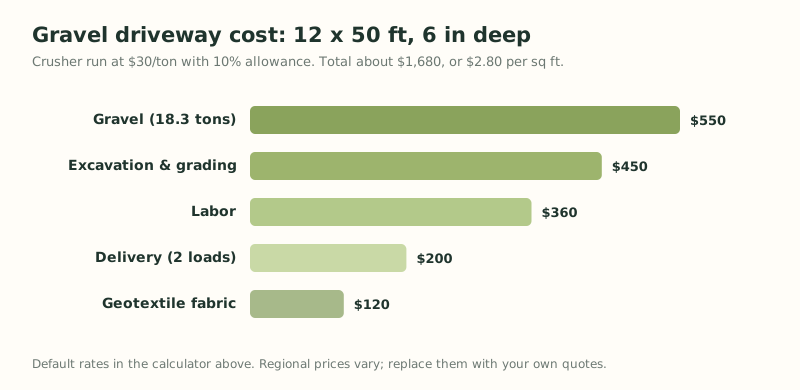
Driveway gravel costs $20 to $65 per ton at the quarry. Crusher run and recycled concrete sit at the low end; washed #57 stone and decorative river rock at the high end. A 600 sq ft driveway at 6 inches deep takes about 18 tons of crusher run, or roughly $550 of material.
Delivery
Most quarries charge $75 to $200 per truckload depending on distance. A tandem dump truck carries 13 to 15 tons, so the calculator rounds your tonnage up to whole loads — a partial load usually costs as much to deliver as a full one.
Excavation and grading
Removing sod and topsoil, shaping a crown and compacting the subgrade costs about $0.50 to $2.00 per square foot. It is the line that varies most: a flat, firm lot is cheap; a slope, tree roots or soft clay are not.
Geotextile fabric
Woven driveway fabric costs $0.10 to $0.40 per square foot and stops the gravel from sinking into the soil. It is the cheapest way to make a gravel driveway last, especially over clay.
Labor
Spreading and compacting the stone in lifts adds $0.50 to $1.50 per square foot. Set the labor rate to zero in the calculator if you are renting a skid steer and plate compactor and doing it yourself.
Gravel Driveway Cost by Size
These figures use the calculator defaults: 6 inches of crusher run at $30 per ton with a 10 percent allowance, $100 per delivery, and $1.55 per square foot for excavation, fabric and labor combined.
| Driveway | Area | Gravel | Gravel cost | Installed cost |
|---|---|---|---|---|
| Single car, 10 × 40 ft | 400 sq ft | 12.2 tons | $367 | about $1,090 |
| Single car, 12 × 50 ft | 600 sq ft | 18.3 tons | $550 | about $1,680 |
| Two car, 20 × 50 ft | 1,000 sq ft | 30.6 tons | $917 | about $2,770 |
| Long, 12 × 150 ft | 1,800 sq ft | 55 tons | $1,650 | about $4,940 |
| Rural, 12 × 300 ft | 3,600 sq ft | 110 tons | $3,300 | about $9,780 |
Gravel Driveway Cost by Gravel Type
Material cost per square foot changes with both the price per ton and the density of the stone. Figures include a 10 percent allowance.
| Gravel type | Typical price | 4 in deep | 6 in deep |
|---|---|---|---|
| Recycled concrete | $20/ton | $0.35/sq ft | $0.53/sq ft |
| Crusher run | $30/ton | $0.61/sq ft | $0.92/sq ft |
| Crushed limestone | $35/ton | $0.67/sq ft | $1.00/sq ft |
| #57 crushed stone | $38/ton | $0.72/sq ft | $1.08/sq ft |
| Pea gravel | $45/ton | $0.82/sq ft | $1.24/sq ft |
The cheapest stone is often also the best driveway stone. Crusher run compacts into a firm surface; pea gravel and river rock roll underfoot and under tires, so they cost more and perform worse on a driveway.
How the Gravel Driveway Cost Calculator Works
The calculator multiplies length × width × depth to get cubic feet, divides by 27 for cubic yards, adds the waste allowance, and multiplies by the gravel's bulk density to get tons. Tons × price per ton is the material cost. Tons ÷ truck capacity, rounded up, gives the number of deliveries. Excavation, fabric and labor are charged on the driveway footprint in square feet. The sum is your total gravel driveway cost, and dividing by the footprint gives the cost per square foot.
How to Lower Gravel Driveway Cost
- Order full truckloads. Delivery is charged per load, so 13 tons costs the same to deliver as 6.
- Use recycled concrete for the base. It costs a third less than virgin stone and compacts just as well under a crusher run top layer.
- Do not skip the fabric. It costs a few hundred dollars and saves topping up sunken gravel every year.
- Get the crown right. A driveway that sheds water needs far less maintenance, which is where the long-term gravel driveway cost really sits.
Related Gravel Calculators
These tools use the same volume and density maths for neighbouring jobs:
- Driveway gravel calculator — tonnage by layer for a driveway build-up
- Gravel cost calculator — material, delivery and tax for any gravel order
- Gravel road calculator — long private roads and farm lanes by the mile
- Crusher run calculator — the usual driveway base and surface stone
- Gravel base calculator — compacted base for slabs, sheds and pavers
- How much does gravel cost? — price per ton and per yard by material
Gravel prices on this page reflect typical US quarry pricing; the USGS crushed stone statistics publish national production volumes and average unit values.
Gravel Driveway Cost FAQ
How much does a gravel driveway cost?
A new gravel driveway usually costs $1.50 to $4.00 per square foot installed, so a 12 by 50 ft single-car driveway runs about $900 to $2,400. Resurfacing with 2 inches of new gravel costs $0.30 to $0.75 per square foot.
How much gravel do I need for a driveway?
Multiply length by width by depth in feet, divide by 27 for cubic yards, then multiply by 1.5 for crusher run. A 12 by 50 ft driveway at 6 inches deep needs about 11 cubic yards, or 18 tons with a 10 percent allowance.
What is the cheapest gravel for a driveway?
Recycled concrete and crusher run are the cheapest driveway gravels at about $15 to $30 per ton. Both compact into a firm surface, which also makes them better driveway materials than more expensive decorative stone.
Is a gravel driveway cheaper than asphalt or concrete?
Yes. A gravel driveway costs roughly a third to a fifth of asphalt and concrete, which typically run $7 to $15 per square foot installed. Gravel does need regular top-ups and grading, while asphalt and concrete cost more up front but less to maintain.
How often does a gravel driveway need new gravel?
Plan on topping up a gravel driveway with about 1 to 2 inches of new stone every two to three years, plus regrading when ruts or potholes appear. Good drainage and a fabric layer stretch that interval considerably.