Free online tool • Loose vs compacted
Gravel Compaction Calculator
This gravel compaction calculator answers the question every base layer raises: how much loose gravel do I need to end up with a given compacted depth? Enter the area and the finished compacted depth, pick the gravel, and it applies the right compaction factor to give tons, loose cubic yards and the depth to spread.
How Much Loose Gravel for a Compacted Depth?
Why Gravel Compaction Changes Your Order
Gravel is sold and delivered loose, but a base layer is measured after it has been compacted. Running a plate compactor or roller over dense-graded gravel squeezes the air out from between the stones, so 6 inches of loose crusher run ends up as about 5 inches of compacted base. If you order exactly the compacted volume you need, you will run out. The gravel compaction calculator works backwards from the finished depth to the loose quantity you actually have to buy.
Gravel Compaction Factors
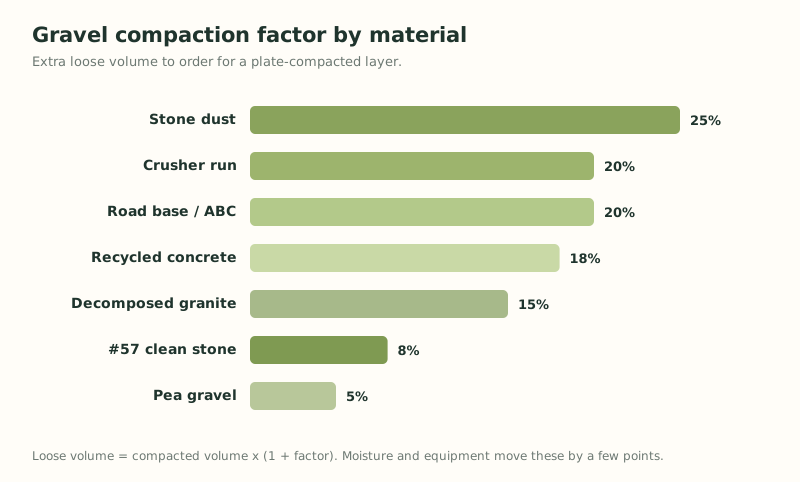
The compaction factor is the extra loose volume needed to reach a compacted volume. It depends mostly on how much fine material the gravel contains:
| Gravel | Typical compaction factor | Loose yards per compacted yard |
|---|---|---|
| Stone dust / screenings | 20–30% | 1.25 |
| Crusher run / DGA | 15–25% | 1.20 |
| Road base / ABC / 3/4 minus | 15–25% | 1.20 |
| Recycled concrete | 15–20% | 1.18 |
| Decomposed granite | 10–20% | 1.15 |
| #57 clean stone | 5–10% | 1.08 |
| Pea gravel | 3–5% | 1.05 |
The calculator fills in the typical factor when you choose a gravel. Override it with your supplier's figure if they publish one — some quarries quote a compacted density in tons per cubic yard, which you can turn into a factor by dividing it by the loose density.
How the Gravel Compaction Calculator Works
1. Compacted gravel volume
Multiply length by width by the finished compacted depth in feet, then divide by 27. A 12 × 50 ft driveway base 6 inches deep is 600 × 0.5 ÷ 27 = 11.1 cubic yards compacted.
2. Loose gravel volume
Multiply by 1 plus the compaction factor. For crusher run at 20 percent: 11.1 × 1.20 = 13.3 loose cubic yards.
3. Tons of gravel
Multiply the loose volume by the loose bulk density: 13.3 × 1.50 = 20 tons of crusher run.
4. Loose gravel depth
Multiply the compacted depth by the same factor: 6 × 1.20 = 7.2 inches. Spread to this depth, and the gravel should compact down to the 6 inches you want.
Gravel Compaction in Lifts
A plate compactor only reaches 3 to 4 inches into gravel, so thick layers must go down in lifts. Spread 2 to 4 inches of loose gravel, compact it, then add the next lift. For a 6 inch compacted base, spread about 3.6 inches of loose crusher run twice. Lightly dampen dense-graded gravel before compacting — dry fines will not bind, and soaking-wet gravel pumps and squirms under the plate.
How to tell gravel compaction is done
Make passes until the compactor stops leaving marks and the surface rings rather than thuds. On engineered work, compaction is specified as a percentage of the material's maximum laboratory density from a Proctor test, often 95 percent, and checked with a nuclear density gauge. For a patio or shed base, a firm surface that you cannot dent with a boot heel is a good field test.
Gravel Compaction vs Waste
The compaction factor is not the same as a waste allowance. Compaction accounts for the volume the gravel loses when it is pressed down; waste covers what is lost to uneven subgrade, spillage and the edges. For dense-graded base gravel the compaction factor usually covers both on a well-prepared site. On rough, uneven ground add another 5 percent on top of the factor in the gravel compaction calculator.
Related Gravel Calculators
These tools use the same volume and density maths for neighbouring jobs:
- Stone dust calculator — screenings for paver bedding, compaction included
- Gravel base calculator — base depth by project
- Crusher run calculator — the most common compacted base
- ABC gravel calculator — aggregate base course, Class 5 and 2B
- Gravel pad calculator — compacted pads for sheds and RVs
- Gravel road calculator — compacted road gravel by the mile
- Cubic yards to tons calculator — convert loose volume to weight
Compaction practice on this page follows standard pavement base construction; the FHWA pavement program publishes guidance on base course materials and compaction testing.
Gravel Compaction FAQ
How much does gravel compact?
Dense-graded gravel with fines, such as crusher run, road base and 3/4 minus, compacts about 15 to 25 percent. Clean stone such as #57 compacts only 5 to 10 percent, and round pea gravel 3 to 5 percent.
How much loose gravel do I need for 4 inches compacted?
For crusher run, spread about 4.8 inches of loose gravel to get 4 inches compacted, which means ordering 20 percent more volume than the compacted layer. For #57 stone, about 4.3 inches loose is enough.
What is the compaction factor for crusher run?
Use about 1.20, meaning 20 percent more loose volume than the compacted volume. The real figure ranges from 1.15 to 1.25 depending on moisture, gradation and the compactor used.
How thick can each lift of gravel be?
Keep each lift to 2 to 4 inches loose when using a plate compactor. A heavy vibratory roller can compact lifts of 6 inches or more.
Does #57 stone need to be compacted?
Clean #57 stone settles slightly and benefits from a few passes of a plate compactor, but it never becomes a solid layer because it has no fines. Order 5 to 10 percent extra to cover settling.