Free online tool • Edge overhang included
Gravel Under Concrete Slab Calculator
This gravel under concrete slab calculator tells you how much gravel to put under a concrete patio, garage floor, shed slab or driveway. Enter the slab size and base depth, and it adds the gravel that extends past the slab edges to give tons, cubic yards, bags and cost.
How Much Gravel Under a Concrete Slab?
Why Gravel Goes Under a Concrete Slab
Concrete is strong in compression but cracks when the ground beneath it moves. A compacted layer of gravel under the concrete slab gives it a uniform, stable bed, breaks the capillary path that wicks ground moisture up into the slab, and lets water drain away instead of freezing and heaving under it. On a garage floor or house slab it also gives a flat surface for the vapor barrier and reinforcement chairs.
How Much Gravel Under a Concrete Slab?
The standard answer is 4 inches of compacted gravel under a residential concrete slab. Go to 6 inches under garage floors and concrete driveways that carry vehicles, and to 6 to 8 inches on clay or poorly drained soil.
What the building code says
The International Residential Code (section R506.2.2) calls for a 4 inch base course of clean graded sand, gravel, crushed stone or crushed concrete under floor slabs that sit below grade, unless the site soil is already free-draining sand and gravel. Local codes may add to this, so check with your building department for a house or garage slab.
Gravel past the slab edges
Extend the gravel 6 to 12 inches beyond the slab on every side so the edges and the form stakes sit on a supported base. The gravel under concrete slab calculator adds this overhang automatically — on a 20 × 20 ft slab, a 6 inch overhang turns 400 sq ft into 441 sq ft of gravel.
Best Gravel for Under a Concrete Slab
- 3/4 crushed stone (#57) — clean, angular and free-draining. The most common gravel under a concrete slab, especially for house slabs with a vapor barrier.
- 3/4 minus or crusher run — compacts harder than clean stone and is popular under patios, sheds and driveways where a firm working surface helps the pour.
- Road base — similar to crusher run; often what a concrete contractor brings for driveways.
- Recycled concrete — cheaper and environmentally sound; check it is free of rebar and debris.
- Clean graded sand — allowed by code, though it washes out more easily than stone.
- Pea gravel — round stones roll under foot and under the screed, so pea gravel is a poor choice under a slab.
How the Gravel Under Concrete Slab Calculator Works
1. Add the overhang to the slab size
For a 20 × 20 ft slab with 6 inches of overhang on each side, the gravel area is 21 × 21 = 441 sq ft.
2. Multiply by the gravel depth
At 4 inches (0.333 ft): 441 × 0.333 = 147 cubic feet, divided by 27 = 5.44 cubic yards.
3. Convert to tons
Multiply by the density: 5.44 × 1.40 = 7.6 tons of 3/4 crushed stone. Add 10 percent and order about 8.4 tons, or 15 percent if you are using crusher run that will be compacted.
Gravel Under Concrete Slab Sizes
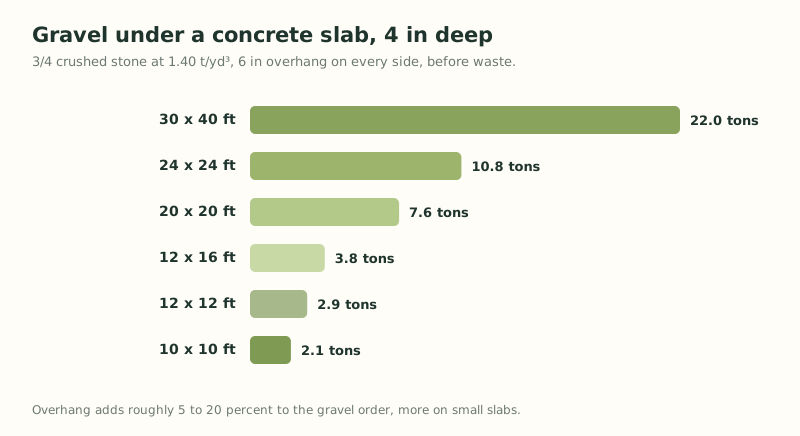
| Slab size | Gravel area (6 in overhang) | Cubic yards at 4 in | Tons of 3/4 stone |
|---|---|---|---|
| 10 × 10 ft | 121 sq ft | 1.49 | 2.1 |
| 12 × 12 ft | 169 sq ft | 2.09 | 2.9 |
| 12 × 16 ft | 221 sq ft | 2.73 | 3.8 |
| 20 × 20 ft | 441 sq ft | 5.44 | 7.6 |
| 24 × 24 ft | 625 sq ft | 7.72 | 10.8 |
| 30 × 40 ft | 1,271 sq ft | 15.69 | 22.0 |
Preparing Gravel Under a Concrete Slab
Strip topsoil and organic material, then compact the subgrade. Spread the gravel in lifts of no more than 4 inches and run a plate compactor over each lift until it no longer moves underfoot. Screed the top flat to the planned slab thickness — a high spot in the gravel becomes a thin spot in the concrete. For interior slabs, lay a 6-mil polyethylene vapor retarder over the gravel with the seams lapped at least 6 inches before setting the reinforcement.
Related Gravel Calculators
These tools use the same volume and density maths for neighbouring jobs:
- Gravel base calculator — base depth for pavers, sheds, walkways and driveways
- 3/4 gravel calculator — clean 3/4 stone and 3/4 minus by the ton
- Patio gravel calculator — patio base and surface layers
- Shed base gravel calculator — gravel pads for standard shed sizes
- Crusher run calculator — compactable base under slabs and driveways
- Cubic yards to tons calculator — convert any gravel volume to tons
Slab sub-base practice on this page follows residential code and industry guidance; the American Concrete Institute publishes the guides for concrete floor and slab construction that most specifications reference.
Gravel Under Concrete Slab FAQ
How much gravel do I need under a concrete slab?
Plan on 4 inches of compacted gravel under a typical residential concrete slab and 6 inches under garage floors and driveways. Extend it 6 to 12 inches past the slab edges. A 20 by 20 ft slab needs about 5.4 cubic yards, or 7.6 tons of 3/4 crushed stone.
Do you need gravel under a concrete slab?
On most soils, yes. Gravel gives the slab a uniform, well-drained base and reduces cracking from settlement and frost. The residential building code requires a 4 inch base course under slabs below grade unless the native soil is already free-draining sand and gravel.
What size gravel goes under a concrete slab?
3/4 inch crushed stone (#57) or 3/4 minus is the usual choice. Angular stone locks together and stays put under the concrete, while round pea gravel shifts and is best avoided.
How many bags of gravel do I need under a 10x10 slab?
A 10 by 10 ft slab with a 6 inch overhang at 4 inches deep needs about 1.5 cubic yards, or 2.1 tons. That is about 92 bags of 50 lb with a 10 percent allowance, so bulk delivery is usually cheaper.
Should I put plastic over the gravel under a slab?
For interior slabs such as house and garage floors, lay a 6-mil polyethylene vapor retarder over the compacted gravel with seams lapped at least 6 inches. Outdoor patios and sidewalks usually go straight onto the gravel.