Free online tool • Erosion control stone
Rip Rap Calculator
This rip rap calculator estimates how much riprap stone a shoreline, stream bank, ditch, culvert outlet or slope needs. Pick the stone size, enter the length and the width measured along the slope, and it sets the layer thickness and gives tons, cubic yards, truckloads and cost.
How Much Rip Rap Do I Need?
What Is Rip Rap?
Rip rap (also written riprap) is large, angular stone placed on a bank, shoreline or channel to stop moving water from eroding the soil underneath. Unlike gravel, rip rap is not graded to a single size: a load contains a range of stones, described by the median size, D50 — half the stones by weight are larger and half smaller. The heavier the water flow or wave action, the larger the D50 and the thicker the layer.
Rip Rap Sizes and Layer Thickness
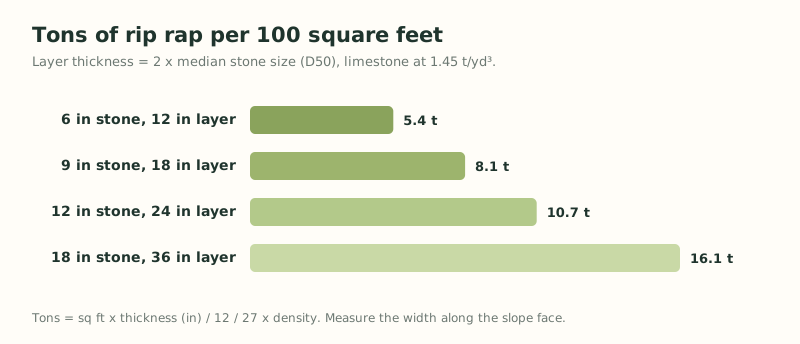
The standard rule from federal and state erosion-control manuals is to make the layer at least 1.5 to 2 times the D50, and never thinner than the largest stone. The rip rap calculator uses 2 × D50, the more common recommendation for banks and shorelines.
| Median stone (D50) | Typical median stone weight | Layer thickness | Tons per 100 sq ft | Typical use |
|---|---|---|---|---|
| 6 in | about 10 lb | 12 in | 5.4 | Ditches, small outlets |
| 9 in | about 35 lb | 18 in | 8.1 | Ponds, culvert outlets |
| 12 in | about 85 lb | 24 in | 10.7 | Stream banks, lake shores |
| 18 in | about 290 lb | 36 in | 16.1 | High-velocity channels |
State DOTs sell rip rap by class (Class A, Class B, Class I, Class II and so on), but the size ranges behind each class differ from state to state. Ask the quarry for the D50 of the class they stock and pick the closest size in the calculator, or type the layer thickness directly.
How the Rip Rap Calculator Works
1. Measure along the slope
Rip rap covers the sloped face, not its footprint. Measure the length of the bank and the width from the toe to the top along the slope. A 50 ft shoreline with a 10 ft slope face is 500 sq ft.
2. Cubic yards of rip rap
Multiply by the layer thickness in feet and divide by 27. With 9 inch stone in an 18 inch layer: 500 × 1.5 ÷ 27 = 27.8 cubic yards.
3. Tons of rip rap
Multiply by the density. Placed rip rap weighs about 1.40 to 1.50 tons per cubic yard because of the large voids between stones: 27.8 × 1.45 = 40.3 tons. Add 15 percent for the toe trench and uneven placement and order about 46 tons — three 20-ton loads.
Rip Rap Weight per Cubic Yard
Solid rock weighs about 2.2 tons per cubic yard, but a rip rap layer is 30 to 40 percent voids, so the placed weight is much lower. Granite is the densest; broken concrete is lighter and much cheaper where local rules allow it.
| Rip rap stone | Tons per cubic yard (placed) | Typical price per ton |
|---|---|---|
| Granite | 1.50 | $45–$75 |
| Limestone | 1.45 | $35–$60 |
| Fieldstone | 1.40 | $30–$55 |
| Broken concrete | 1.25 | $0–$25 |
Fabric and Bedding Under Rip Rap
Water moving through the voids will wash out the soil behind rip rap unless something holds it back. Lay a non-woven geotextile over the graded slope, or a 6 inch bedding layer of crushed stone, before placing the stone. Key the bottom of the rip rap into a toe trench about as deep as the layer is thick so it cannot slide. The calculator adds geotextile at $0.35 per sq ft by default; set it to 0 if you are using a gravel filter instead and estimate that layer with the crushed stone calculator.
Rip Rap Cost
Rip rap stone costs about $35 to $75 per ton at the quarry, with larger classes at the top of the range. Delivery in a 20-ton tri-axle runs $100 to $200 per load nearby. Placement by excavator typically adds $40 to $90 per ton, and permits may be required for work along a stream, lake or wetland — check with your local conservation district before ordering.
Related Stone Calculators
Other tools for drainage and erosion work:
- Stone calculator — every stone type in tons and yards
- Crushed stone calculator — the bedding layer under rip rap
- French drain calculator — clean stone for drainage trenches
- River rock calculator — rounded stone for dry creek beds
- Cubic yards to tons calculator — convert any stone volume to weight
Sizing follows the 1.5 to 2 × D50 thickness rule in the FHWA hydraulic engineering circulars and state erosion-control manuals. For streams and engineered channels, have the D50 set by a qualified engineer.
Rip Rap FAQ
How do I calculate how much rip rap I need?
Multiply the length of the bank by the width measured along the slope for square feet. Multiply by the layer thickness in inches divided by 12, divide by 27 for cubic yards, then multiply by about 1.45 tons per cubic yard. Add 10 to 15 percent for the toe trench and uneven placement.
How thick should rip rap be?
At least 1.5 to 2 times the median stone size (D50), and never thinner than the largest stone. 6 inch rip rap needs a 9 to 12 inch layer, 12 inch rip rap an 18 to 24 inch layer.
How much does a cubic yard of rip rap weigh?
Placed rip rap weighs about 1.4 to 1.5 tons, or 2,800 to 3,000 lbs, per cubic yard. The voids between the large stones make it lighter than smaller crushed stone of the same rock.
How many square feet does a ton of rip rap cover?
One ton of limestone rip rap covers about 19 sq ft as 6 inch stone in a 12 inch layer, 12 sq ft in an 18 inch layer and 9 sq ft in a 24 inch layer.
Do you need fabric under rip rap?
Yes, in almost every case. A non-woven geotextile or a 6 inch crushed stone bedding layer stops the soil behind the rip rap from washing out through the gaps between stones.
How much does rip rap cost?
Rip rap stone costs about $35 to $75 per ton, plus $100 to $200 per truckload for delivery. Installed by excavator, expect about $80 to $165 per ton in total.