Free online tool • Grade-specific density
Limestone Calculator
This limestone calculator works out how much crushed limestone a driveway, base layer, walkway, or drainage trench needs. Enter the area, finished depth, and limestone grade to get cubic yards, tons, bag counts, and material cost.
How Much Limestone Do I Need?
Coverage falls as depth rises. Ask your supplier for their own bulk density before a full truckload — quarry figures vary by a few percent, and that is enough to change a large order.
Limestone Weight and Bulk Density
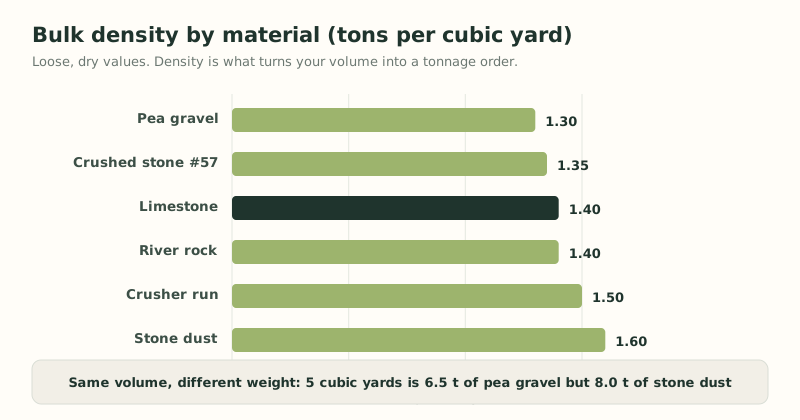
Crushed limestone weighs roughly 1.35 to 1.40 tons per cubic yard in its loose, dry state — about 2,700 to 2,800 lbs. That single figure is what converts the volume you measured into the tonnage a quarry will actually sell you, and it is the number most DIY estimates get wrong.
Bulk density is not the density of the rock itself. Solid limestone has a specific gravity near 2.55, which would be well over two tons per cubic yard. What you are buying is crushed stone with air between the pieces, and how much air depends entirely on the grade.
Why limestone density varies by grade
A clean, washed grade like #57 limestone has had its fines screened out, so the voids between the 3/4-inch pieces stay open and the material measures lighter. Crusher run limestone keeps its fines, which fill those voids and push the density to about 1.50 tons per cubic yard. Limestone screenings — essentially all fines — reach roughly 1.60.
Moisture adds weight too. Stone that has sat through a week of rain can run 5 to 10 percent heavier than the quarry's published dry figure, which matters when you are buying by weight and spreading by volume.
Limestone Grades and Sizes
Limestone is sold by numbered grade, and the number refers to the size the stone passes through during screening. Picking the wrong grade is the most common reason a limestone driveway fails within a season.
#57 limestone (3/4 inch)
The most widely used grade. Clean, angular, roughly 3/4 inch, with no fines. It drains freely and is the standard choice for driveway surfaces, French drains, and concrete aggregate. Because it has no fines it will not compact into a hard surface on its own — it stays loose and shifts underfoot.
#8 limestone (3/8 inch)
A smaller washed grade, often used as a top dressing over a compacted base, as paver bedding, or in drainage applications where a finer stone is wanted. At about 1.35 tons per cubic yard it is marginally lighter than #57.
#4 limestone (1.5 inch)
A large grade used as the bottom layer of a deep driveway build-up or for erosion control. It creates a stable, free-draining foundation but is far too coarse to walk or drive on directly.
Crusher run limestone
A dense-graded mix of stone and fines, also sold as dense grade aggregate or DGA. The fines lock the angular pieces together under compaction, which makes this the correct material for a driveway base, a shed pad, or any layer that has to carry load. At about 1.50 tons per cubic yard it is the heaviest common driveway grade.
Limestone screenings
The finest product, close to a coarse sand with stone dust. Used as a levelling course under pavers and flagstone. It compacts hard and sheds water rather than draining it, so it should never be the only layer on a driveway.
How Much Area Does a Ton of Limestone Cover?
At 1.40 tons per cubic yard, one ton of #57 limestone covers about 116 square feet at 2 inches deep, 77 square feet at 3 inches, 58 square feet at 4 inches, and 39 square feet at 6 inches. The relationship is straightforward: double the depth and you halve the coverage.
Those figures drop for the denser grades. Crusher run at 1.50 tons per cubic yard covers roughly 7 percent less area per ton than #57, and screenings at 1.60 cover about 14 percent less. If you are comparing supplier quotes across grades, compare cost per square foot at your actual depth rather than cost per ton.
How to Calculate Limestone Step by Step
The calculator above does this automatically, but the manual process is worth understanding — it is also how you check a supplier's quote.
1. Measure the area
For a rectangle, multiply length by width in feet. For a circle, use π × radius². For an irregular shape, break it into rectangles, calculate each, and add them together. A 20 ft × 12 ft driveway apron is 240 square feet.
2. Choose a finished depth
Use 2 to 3 inches for a limestone surface course over an existing base, 4 to 6 inches for a driveway base layer, 3 inches for a walkway, and 6 to 12 inches for a drainage trench. Convert to feet by dividing by 12: 4 inches is 0.333 ft.
3. Convert to cubic yards
Multiply area by depth in feet to get cubic feet, then divide by 27. For the 240 sq ft apron at 4 inches: 240 × 0.333 = 80 cubic feet, ÷ 27 = 2.96 cubic yards.
4. Convert cubic yards to tons
Multiply by the bulk density of your grade. At 1.40 for #57 limestone: 2.96 × 1.40 = 4.14 tons. For crusher run at 1.50 the same volume is 4.44 tons.
5. Add a waste allowance
Add 10 percent for a loose surface course and 15 percent for anything you plan to compact, because graded limestone loses roughly a fifth of its loose depth under a plate compactor. The 4.14-ton apron becomes about 4.6 tons ordered.
Worked example: a 20 × 30 ft limestone driveway
A 600 sq ft driveway built properly needs two layers. The base is 4 inches of crusher run: 600 × 0.333 ÷ 27 = 7.4 cubic yards × 1.50 = 11.1 tons, plus 15 percent for compaction, so order 12.8 tons. The surface is 2 inches of #57: 600 × 0.167 ÷ 27 = 3.7 cubic yards × 1.40 = 5.2 tons, plus 10 percent, so order 5.7 tons. Total: about 18.5 tons, which is roughly one and a half standard dump truck loads.
Limestone Cost
Crushed limestone typically runs $25 to $45 per ton picked up at the quarry. Crusher run sits at the low end because it is the least processed; washed #8 sits at the high end. Delivery adds $50 to $200 depending on distance and load size.
Limestone is usually the cheapest durable driveway material in regions with local quarries, and one of the more expensive where it has to be hauled. Because freight is such a large share of the delivered price, ordering a full truckload — or splitting one with a neighbour — lowers your effective cost per ton far more than shopping for a better material price.
Using the worked example above, 18.5 tons at $32 per ton is about $590 in material, plus roughly $150 delivery, for a total near $740 for a 600 sq ft driveway.
Limestone vs Other Gravel Materials
Against pea gravel, limestone is angular rather than rounded, which means it locks together and stays where you put it instead of migrating underfoot. Pea gravel is more comfortable and more decorative; limestone carries load.
Against river rock, limestone is cheaper, more angular, and available in graded sizes. River rock is a landscaping material; limestone is a construction one.
Against crusher run generally — which may be limestone, granite, or whatever the local quarry produces — the difference is the parent rock rather than the gradation. Limestone is softer than granite and breaks down faster under heavy traffic, but it compacts more readily and is usually less expensive.
Limestone's main drawback is its softness. It powders under repeated heavy vehicle traffic, producing white dust in dry weather and requiring a top-up every few years. Granite holds up longer where that matters.
Related Calculators and Guides
Working out a whole project rather than one material? These tools use the same volume and density maths:
- Driveway gravel calculator — sizes a full driveway build-up by layer
- Crusher run calculator — for the compacted base course under limestone
- #57 gravel calculator — the same grade in other stone types
- Gravel cost calculator — adds delivery and tax to the material figure
- Gravel weight guide — bulk density for every common material
- How deep should gravel be? — finished depth by project type
Density figures on this page follow the standard quarry range for crushed limestone; the USGS crushed stone statistics publish national production and aggregate data if you want the underlying industry source.
Frequently Asked Questions
How much does a cubic yard of limestone weigh?
About 1.35 to 1.40 tons, or 2,700 to 2,800 lbs, for clean crushed limestone. Crusher run is heavier at roughly 1.50 tons per cubic yard, and limestone screenings heavier still at about 1.60.
Which grade of limestone should I use for a driveway?
Crusher run or #4 limestone for the base, finished with 2 to 3 inches of #57. A driveway built entirely from clean #57 stays loose and ruts under vehicle traffic, because there are no fines to lock the stone together.
Does limestone compact more than other gravel?
Graded limestone with fines compacts substantially — expect to lose roughly 20 percent of loose depth. Order 10 to 15 percent extra for any layer you plan to run a compactor over.
How many tons of limestone are in a dump truck?
A standard tandem dump truck carries 12 to 15 tons, a small dump truck 6 to 8 tons, and a full-size pickup should not exceed about 1 ton of limestone. Most quarries charge a flat delivery fee per load, so a partial load costs the same to deliver as a full one.
Can I put limestone directly on soil?
Only for a decorative bed. For anything bearing load, excavate to the full depth, compact the subgrade, and lay geotextile fabric before the first lift of stone — otherwise the limestone works down into the soil and the surface sinks within a season.