Free online tool • Decorative stone
Landscape Gravel Calculator
This landscape gravel calculator estimates how much decorative gravel and stone a flower bed, garden path, tree ring, xeriscape or dry creek bed needs. Choose the landscape project and stone, enter the area, and get tons, cubic yards, bags and cost.
How Much Landscape Gravel Do I Need?
Landscape Gravel Depth by Project
Depth is the setting that matters most in a landscape gravel calculator. Too thin and soil shows through within a season; too thick and the gravel is hard to walk on and costs more than it needs to.
Landscape gravel for beds and tree rings
Use 2 inches of pea gravel or small river rock, or 2 to 3 inches of larger stone. Keep landscape gravel 3 to 6 inches away from tree trunks so the bark stays dry.
Landscape gravel for paths
3 inches of pea gravel, or 2 to 3 inches of decomposed granite over a compacted base. Decomposed granite packs into a firm surface; pea gravel stays loose and needs edging to keep it on the path.
Xeriscapes and rock gardens
2 to 3 inches of crushed granite, decomposed granite or river rock over landscape fabric. Larger 2 to 4 inch stone needs about twice its own diameter in depth to cover the ground fully.
Dry creek beds
4 inches or more of mixed river rock, with larger cobbles and boulders placed along the banks. Size the bed in the calculator by length and average width.
Play areas
Loose-fill surfacing under playground equipment needs to be much deeper. U.S. safety guidance recommends at least 9 inches of pea gravel, maintained at that depth, under equipment up to 5 feet high.
Types of Landscape Gravel
- Pea gravel — smooth 3/8 inch stones in mixed earth tones. Inexpensive and comfortable underfoot; the default landscape gravel for paths and beds.
- River rock — rounded stone from 1 to 3 inches and up. Ideal for dry creek beds, downspout splash areas and borders.
- Decomposed granite — fine, sandy granite that compacts into a natural-looking path or patio surface.
- Crushed granite — angular 1/4 to 3/4 inch stone that stays put on slopes and in xeriscapes.
- Marble chips — bright white decorative stone. Avoid it around acid-loving plants, as it slowly raises soil pH.
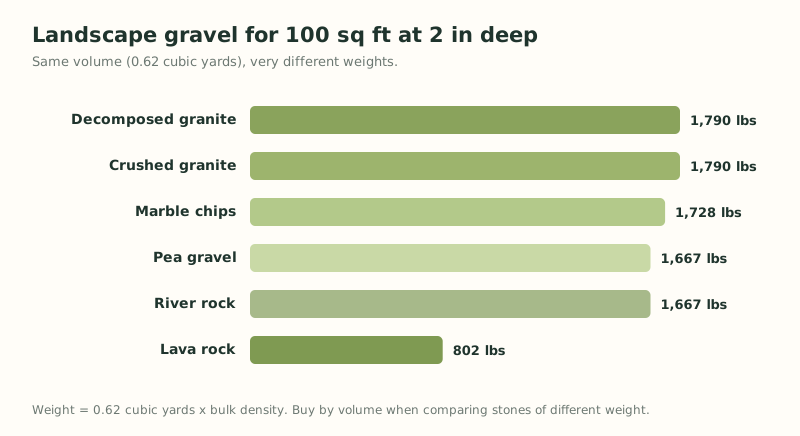
- Lava rock — very light porous stone, less than half the weight of other landscape gravel per yard.
- Beach pebbles — polished black or grey pebbles used as an accent; priced far above other stone.
How the Landscape Gravel Calculator Works
1. Measure the landscape area
For a bed or path, multiply length by width. For a tree ring, measure the diameter and use the circle option. For curved beds, lay a hose around the edge, measure the longest length and average width, and treat it as a rectangle.
2. Convert to cubic yards
Multiply the area by the depth in feet and divide by 27. A 20 × 10 ft bed at 2 inches: 200 × 0.167 ÷ 27 = 1.23 cubic yards.
3. Convert to tons or bags
Multiply cubic yards by the stone's density. At 1.35 tons per cubic yard for pea gravel that is 1.67 tons, or about 1.8 tons with 10 percent extra. In 50 lb bags it is about 73 bags — the landscape gravel calculator does this for every stone in the list.
Landscape Gravel Coverage
| Depth | 1 cubic yard covers | 1 ton of pea gravel covers | 1 yard of lava rock weighs |
|---|---|---|---|
| 2 in | 162 sq ft | 120 sq ft | about 1,300 lbs |
| 3 in | 108 sq ft | 80 sq ft | about 1,300 lbs |
| 4 in | 81 sq ft | 60 sq ft | about 1,300 lbs |
| 9 in | 36 sq ft | 27 sq ft | about 1,300 lbs |
Landscape Gravel Cost
Bulk landscape gravel from a stone yard costs roughly $35 to $60 per ton for pea gravel and crushed granite, $50 to $150 per ton for river rock, $100 to $300 for marble chips, and several hundred dollars per ton for polished beach pebbles. Lava rock is usually sold by the cubic yard at $80 to $150. Bagged landscape stone at a garden center costs three to six times the bulk price, so bags only make sense for areas under about 50 square feet.
Landscape Gravel Installation Tips
Remove weeds and grass, rake the soil level, and lay a woven landscape fabric before spreading the stone so weeds do not come up through the gravel. Install edging — steel, stone or plastic — to keep landscape gravel out of the lawn. Spread to the full depth in one pass and rake it level; decomposed granite paths should be dampened and compacted.
Related Gravel Calculators
These tools use the same volume and density maths for neighbouring jobs:
- Garden gravel calculator — beds and borders by shape
- Pea gravel calculator — the most popular landscape gravel
- River rock calculator — rock sizes from 1 to 6 inches
- Walkway gravel calculator — paths with base and surface layers
- Gravel bags calculator — bag counts for small projects
- Gravel size chart — stone sizes and their uses
Play area depth follows the CPSC Public Playground Safety Handbook, which lists minimum loose-fill depths for pea gravel and other surfacing materials.
Landscape Gravel FAQ
How much landscape gravel do I need?
Multiply the length by the width in feet, then by the depth in inches divided by 12, and divide by 27 for cubic yards. A 20 by 10 ft bed at 2 inches deep needs about 1.2 cubic yards, or roughly 1.8 tons of pea gravel with 10 percent extra.
How deep should landscape gravel be?
Use about 2 inches in flower beds and around trees, 3 inches on paths and in xeriscapes, 4 inches or more in dry creek beds, and at least 9 inches of pea gravel under play equipment.
How many bags of landscape gravel make a ton?
A ton is 2,000 lbs, so it takes 40 bags of 50 lb or 50 bags of 40 lb. A cubic yard of pea gravel weighs about 2,700 lbs, or 54 bags of 50 lb.
What is the cheapest landscape gravel?
Pea gravel and crushed granite are usually the cheapest landscape gravel at about $35 to $60 per ton in bulk. River rock costs more, and marble chips and polished beach pebbles are the most expensive.
Do I need landscape fabric under gravel?
Landscape fabric is strongly recommended under decorative gravel. It keeps the stone from sinking into the soil and blocks most weeds, so the gravel stays clean and at full depth much longer.